
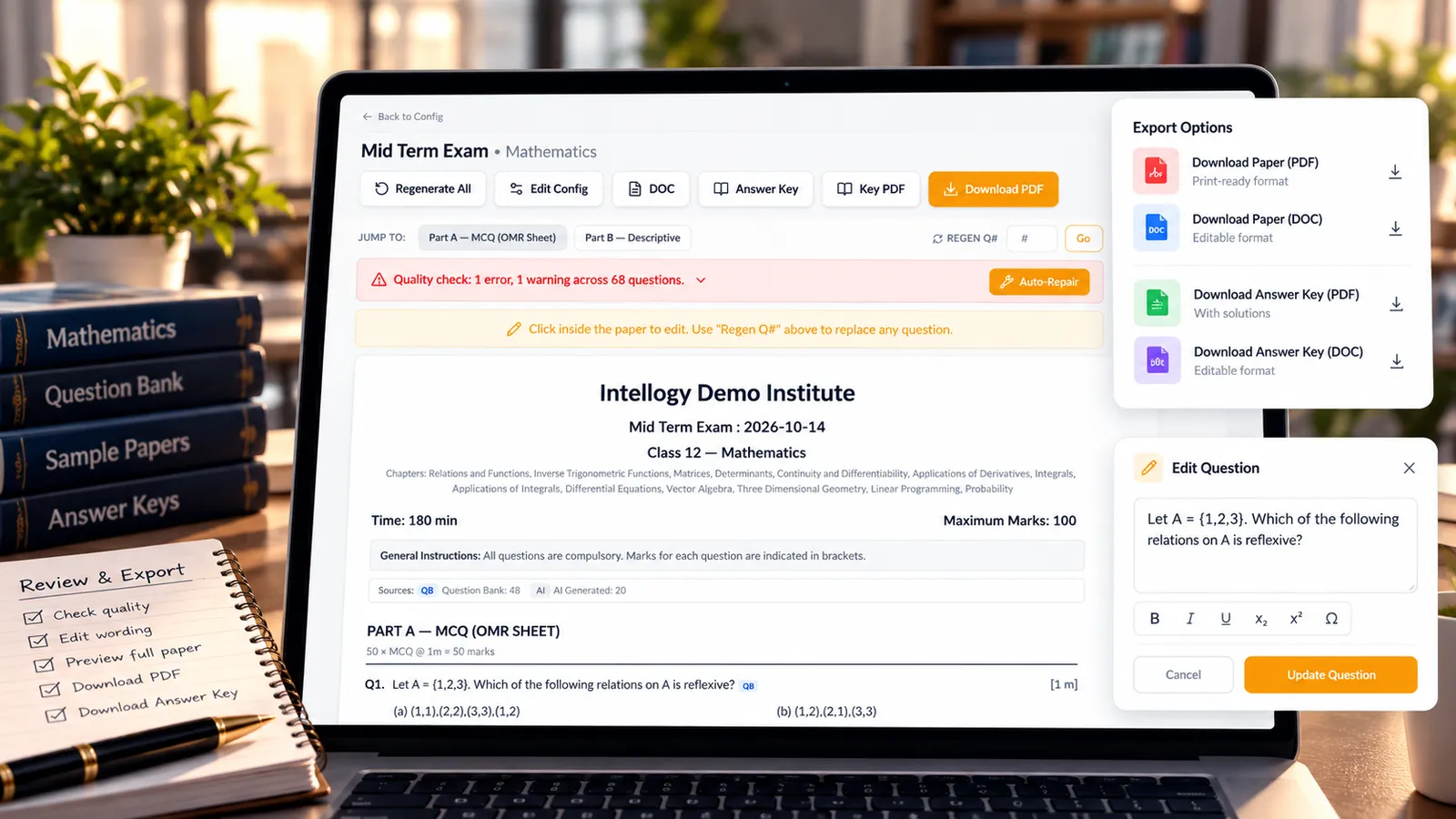
A good practice paper is a teaching tool, not just a formality. A rushed one can give students false confidence or test them on the wrong things. Here is a repeatable method for building better papers — whether you set them by hand or with help from software.
Define the syllabus scope first
Before a single question goes in, be explicit about what the paper is testing. Which chapters, and how much weight does each deserve?
- List the exact chapters in scope for this paper
- Assign marks to each chapter based on importance and recency
- Decide the total marks and duration up front
Choose your question types deliberately
Different question types test different things. A paper that’s all MCQs tests recognition; one that’s all long-answer tests endurance. Mix them on purpose.
- MCQs for quick coverage and exam-pattern practice
- Short answers for reasoning and method
- Long answers for depth and structured thinking
Balance the difficulty
A paper where everything is hard discourages; one where everything is easy misleads. A deliberate easy / medium / hard split keeps the paper honest and the result meaningful.
The Intellogy AI Test Generator lets you set chapter weightage and an easy/medium/hard split, then builds a balanced paper from a verified bank plus AI. See it work on your syllabus.
Request a Test Generator demonstrationCheck wording and duplicates
The fastest way to undermine a good paper is a confusing question or the same idea asked twice. A quick quality pass catches both.
- Read each question as a student would — is it unambiguous?
- Check that no two questions test the exact same point
- Confirm the marks add up and the sections are labelled
Keep the final review with the educator
This is the step that should never be automated away. Whether a paper was assembled by hand or generated, a teacher should read it end to end and sign off. Software can do the heavy lifting of selection and balancing; academic responsibility stays with the educator.
- Review the full paper in one sitting
- Fix or regenerate any weak question
- Confirm it matches what you actually taught
- Only then, finalise and print
Follow this method and your papers become a consistent part of teaching — not a weekend scramble that varies with how tired you were when you set them.
See a balanced, board-ready paper generated for your subject and chapters in a short demo.
See the product workflow